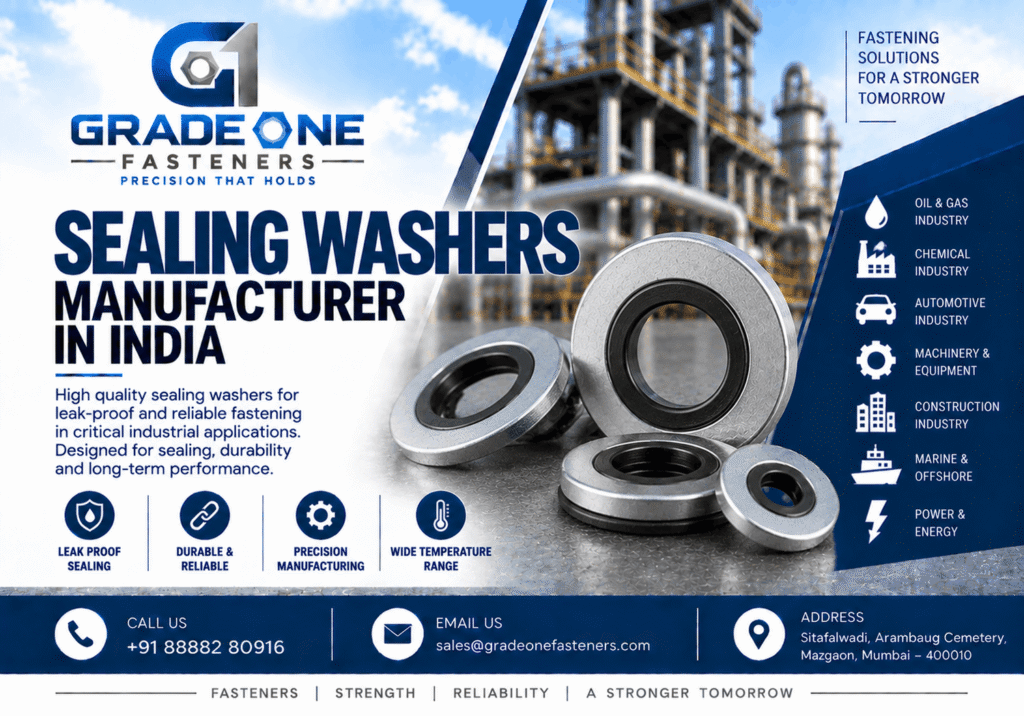
Sealing Washer Manufacturer and Supplier in India

Sealing Washer Manufacturer in India

Grade One Fasteners is a trusted Sealing Washer Manufacturer in India, supplying high-quality sealing washers for industrial, engineering, construction, automotive, oil and gas, chemical and heavy-duty fastening applications. Sealing washers are designed to create a secure seal between two mating surfaces while supporting the fastening assembly and helping reduce the risk of leakage. In many industrial systems, ordinary washers may provide load distribution but cannot provide the sealing performance required for applications involving liquids, gases, oils, chemicals or other fluids. A properly selected sealing washer helps fill small gaps and irregularities between surfaces, improving sealing performance around bolts, screws and other fasteners. Grade One Fasteners supplies sealing washers in different materials, sizes, configurations and specifications according to customer and project requirements. What Are Sealing Washers? Sealing washers are specialized washers designed to create a seal around a fastening point. They are commonly installed beneath the head of a bolt or screw, or beneath a nut, depending on the assembly design. The primary purpose of a sealing washer is to help prevent leakage through or around the fastening hole. Depending on the design, a sealing washer may use rubber, elastomeric material, metal, bonded material or a combination of materials to achieve the required sealing performance. Sealing washers are widely used in applications where fastening and sealing are both required from the same assembly. How Do Sealing Washers Work? A sealing washer works by creating controlled contact pressure between the washer and the mating surfaces when the fastener is tightened. As the bolt, screw or nut is tightened, the sealing element compresses and conforms to small surface irregularities. This helps close potential paths through which liquids or gases could escape. The performance of a sealing washer depends on several factors, including: Selecting the correct washer is therefore important. A washer that physically fits the bolt is not automatically suitable for the application’s pressure, temperature or chemical conditions. Importance of Sealing Washers in Industrial Applications Leakage can create operational, safety and maintenance problems in industrial equipment. Even a small leak can lead to fluid loss, contamination, corrosion or equipment downtime. Sealing washers help provide additional protection at fastening points where a standard metal washer alone may not provide adequate sealing. Important benefits include: Types of Sealing Washers Different applications require different sealing washer designs. The appropriate type depends on the operating environment and assembly requirements. Rubber Sealing Washers Rubber sealing washers use an elastomeric material to create a flexible sealing surface. They are commonly used where the washer needs to conform to surface irregularities. Bonded Sealing Washers Bonded sealing washers combine a metal washer with a bonded elastomeric sealing element. The metal component provides structural support while the sealing material creates the sealing effect. Metal Sealing Washers Metal sealing washers are used in applications requiring strength, durability and compatibility with specific operating conditions. Their design and material selection depend on the sealing mechanism and application. Elastomeric Sealing Washers Elastomeric sealing washers can be manufactured using different materials depending on temperature, chemical exposure and environmental conditions. Materials Used for Sealing Washers The material selection for sealing washers depends heavily on the operating environment. Material Key Characteristics Typical Applications Stainless Steel Corrosion resistance and durability Marine, outdoor and industrial applications Carbon Steel Strength and economical performance General industrial applications Mild Steel Suitable for standard industrial requirements Construction and fabrication Nitrile Rubber Suitable for many oil-related applications Industrial and mechanical systems EPDM Suitable for specific weather and water-related applications Outdoor and water systems Silicone Suitable for selected temperature-sensitive applications Specialized industrial systems Neoprene Good resistance for selected environmental conditions Industrial sealing applications Other Elastomers Selected according to chemical and temperature requirements Custom applications Material compatibility should always be checked against the actual fluid, temperature, pressure and environmental conditions. Sealing Washer Sizes and Specifications Grade One Fasteners can supply sealing washers according to standard and customer-specific requirements. Specification Available Options Product Sealing Washers Size Standard and custom sizes Inner Diameter As per bolt or screw requirement Outer Diameter As per application specification Material Stainless Steel, Carbon Steel, Mild Steel and other materials Sealing Material Rubber, elastomer and application-specific materials Finish Plain, Zinc Plated and other suitable finishes Application Industrial, Oil & Gas, Automotive, Construction and Engineering Supply Type Standard and custom requirements Custom dimensions can be considered based on drawings, samples and technical specifications. Applications of Sealing Washers Sealing washers are used across industries where fastening points require additional protection against leakage. Oil and Gas Industry Oil and gas systems can operate under demanding environmental and pressure conditions. Sealing washer selection must be based on fluid compatibility, temperature and operating requirements. Chemical Industry Chemical processing systems may involve aggressive fluids. Material selection is particularly important to ensure compatibility between the sealing washer and the operating media. Automotive Industry Sealing washers are used in suitable automotive assemblies where fluid containment and secure fastening are required. Machinery and Equipment Industrial machinery may contain lubrication systems, fluid lines and assemblies where fasteners pass through surfaces requiring sealing. Construction Industry Construction and infrastructure applications may use sealing washers in roofing, cladding, structural and equipment-related fastening systems. Marine and Offshore Industry Marine environments can expose fastening systems to moisture, salt and corrosion. Appropriate material selection is essential for long-term performance. Power and Energy Industry Power generation and energy systems may require sealing solutions for equipment, enclosures and industrial assemblies. Benefits of Using High-Quality Sealing Washers Leak Prevention Support The main purpose of a sealing washer is to help reduce potential leakage around fastening points. Secure Fastening Sealing washers can support both fastening and sealing functions within the same assembly. Improved Equipment Reliability Reducing leakage can help improve the reliability of equipment and systems. Material Flexibility Different metal and sealing materials can be selected according to the application. Suitable for Multiple Industries Sealing washers are used in industrial, automotive, marine, energy and engineering applications. Factors to Consider When Selecting a Sealing Washer Choosing a sealing washer only by its physical size is a mistake. The application conditions must also be considered. Important

Sealing Washer Manufacturer in India Read More »

Self Locking Washers Manufacturer and Supplier in India

Self Locking Washers Manufacturer in India

Grade One Fasteners is a trusted Self Locking Washers Manufacturer in India, supplying high-performance locking washer solutions for industrial, engineering and heavy-duty fastening applications. Self locking washers are designed to improve fastening security by creating resistance against loosening caused by vibration, dynamic loads, movement and repeated operational stress. In industrial assemblies, a standard nut and bolt connection may gradually lose its clamping force when exposed to continuous vibration. Self locking washers help reduce this risk by creating a locking effect between the fastened components. They are widely used in machinery, construction equipment, automotive assemblies, power plants, steel structures, marine systems and other critical applications where secure fastening is important. Grade One Fasteners manufactures and supplies self locking washers in different sizes, materials, grades and configurations according to customer requirements. What Are Self Locking Washers? Self locking washers are specially designed washers used to prevent fasteners from loosening after installation. Unlike ordinary flat washers, locking washers are engineered with features that increase friction, mechanical resistance or surface engagement between the fastener and the joint. When a bolt and nut assembly is subjected to vibration or movement, the locking washer helps maintain the clamping force and reduces the possibility of rotation and loosening. The exact locking mechanism may vary depending on the washer design. Different types of self locking washers can use teeth, serrations, wedge action, spring force or other mechanical features to provide improved fastening security. Why Are Self Locking Washers Important? Fastener loosening is a serious concern in industrial applications. Even a small reduction in clamping force can affect machine performance, structural stability and operational reliability. Self locking washers are used to provide additional security in fastening assemblies where standard fastening methods may not be sufficient. Some important benefits include: Self Locking Washers for Vibration Resistance Vibration is one of the most common causes of fastener loosening. Equipment used in manufacturing plants, construction sites, transportation systems and industrial facilities is often exposed to continuous movement. A properly selected self locking washer helps create additional resistance against rotational loosening. This makes self locking washers useful for assemblies exposed to: The washer should always be selected according to the bolt size, application conditions, material requirements and required locking performance. Materials Available for Self Locking Washers Grade One Fasteners can supply self locking washers in different materials depending on the operating environment and customer requirements. Material Features Common Applications Stainless Steel Corrosion resistance and durability Marine, chemical and outdoor applications Carbon Steel High strength and economical General industrial applications Mild Steel Suitable for standard fastening requirements Construction and fabrication Alloy Steel High strength and improved mechanical performance Heavy-duty engineering Duplex Stainless Steel High corrosion resistance and strength Offshore and marine environments Nickel Alloys Suitable for demanding environments Chemical and high-temperature industries Brass Good corrosion resistance Electrical and specialized applications Material selection should depend on the operating environment, corrosion exposure, temperature and mechanical requirements. Sizes and Specifications of Self Locking Washers Self locking washers can be manufactured and supplied in different sizes and specifications according to project requirements. Available options may include: Specification Available Options Product Self Locking Washers Size Standard and custom sizes Thread Compatibility As per matching bolt or fastener size Material Stainless Steel, Carbon Steel, Alloy Steel, Mild Steel and other materials Finish Plain, Zinc Plated, Hot Dip Galvanized and other finishes Application Industrial, Construction, Automotive, Oil & Gas and Engineering Configuration As per locking washer design and application requirement Supply Type Standard and custom manufacturing Custom specifications can be considered based on drawings, samples and technical requirements. Applications of Self Locking Washers Self locking washers are used across industries where fastening reliability is important. Machinery and Equipment Industrial machinery contains multiple bolted connections exposed to vibration and operational movement. Self locking washers help improve the security of these connections. Construction Industry Construction equipment and structural assemblies may experience vibration, movement and changing loads. Locking washers provide additional fastening support. Automotive Industry Vehicles and automotive components are continuously exposed to vibration and dynamic forces. Self locking washers can be used in suitable fastening applications to improve connection reliability. Oil and Gas Industry Oil and gas equipment operates in demanding conditions where fastening integrity is important. Material and washer selection must be based on the specific operating environment. Power and Energy Industry Power generation equipment, electrical installations and industrial energy systems contain critical fastening points where resistance to loosening can be required. Steel and Metal Industry Heavy industrial machinery used in steel and metal processing often experiences vibration and repeated mechanical loads. Locking washers can support secure fastening systems. Marine and Offshore Applications Marine environments may require corrosion-resistant fastening solutions. Stainless steel and other suitable materials can be selected depending on environmental requirements. Advantages of Choosing Self Locking Washers Self locking washers provide several advantages when used correctly in an engineered fastening assembly. Improved Fastening Security The locking mechanism provides additional resistance against unwanted fastener movement. Reduced Maintenance Requirements Secure fastening can help reduce the frequency of inspections and tightening required in suitable applications. Vibration Resistance Self locking washers are particularly useful in assemblies exposed to vibration and dynamic loading. Wide Material Availability Different materials can be selected according to strength, corrosion resistance and operating conditions. Suitable for Multiple Industries These washers can be used in engineering, construction, machinery, automotive and other industrial sectors. Self Locking Washers Manufacturer and Supplier Grade One Fasteners supplies self locking washers to customers requiring dependable industrial fastening products. Product selection can be customized according to the required dimensions, material, grade and application. When selecting a self locking washer, customers should consider: Selecting the wrong washer simply because it fits physically is a common mistake. The locking system must be appropriate for the actual operating conditions. Quality Requirements for Industrial Self Locking Washers Industrial washers should be manufactured with attention to dimensional consistency and material quality. The performance of a locking washer can depend on its design, hardness, surface condition and compatibility with the complete fastening assembly. For project requirements, customers may request products based on:

Self Locking Washers Manufacturer in India Read More »

Spring Lock Washer Manufacturer and Supplier in India

Spring Lock Washer Manufacturer and Supplier in India

Grade One Fasteners is a reliable Spring Lock Washer Manufacturer in India, supplying industrial spring lock washers for machinery, construction, automotive, structural, power, oil and gas and engineering applications. A spring lock washer, also known as a split lock washer or helical spring washer, is designed to be installed beneath a bolt head or nut in a threaded fastening assembly. Its split and helical construction creates spring action when compressed during tightening. Spring lock washers are commonly used in fastening assemblies where vibration, operational movement and dynamic loading may affect the bolted joint. Product selection should always consider the complete joint design, material, preload and application conditions. Spring lock washer configurations are commercially available in multiple standards, materials, sizes and finishes. Spring Lock Washer Manufacturer and Supplier in India Grade One Fasteners supplies spring lock washers for industrial customers requiring dependable fastening components for standard and project-specific applications. A properly selected washer is part of the complete fastening system. The washer must be compatible with the bolt size, material, operating environment and required mechanical performance. Spring lock washers can be supplied according to requirements involving: Spring lock washers are commercially available in spring steel, carbon steel, stainless steel and other materials depending on the application. What is a Spring Lock Washer? A spring lock washer is a split washer with a helical or spring-shaped profile. It is placed between the nut or bolt head and the connected component. When the fastener is tightened, the washer is compressed as part of the bolted assembly. Spring lock washers are commonly used where a fastening system requires resistance to movement and loosening under suitable service conditions. The product may also be referred to as: Different spring washer designs and cross-sections are available depending on the applicable standard and engineering requirement. How Does a Spring Lock Washer Work? A spring lock washer works as part of the complete bolted connection. During installation: The actual resistance of a bolted joint to loosening depends on multiple factors, including bolt preload, vibration, joint material, surface condition and fastening design. For severe vibration or safety-critical applications, the complete locking system should be selected according to engineering requirements rather than assuming a standard spring washer alone will provide sufficient protection. Spring Lock Washer Specifications Specification Available Options Product Spring Lock Washer Alternative Name Split Lock Washer Alternative Name Helical Spring Washer Type Helical / Split Type Material Spring Steel Material Carbon Steel Material Mild Steel Material Stainless Steel Material Alloy Steel Stainless Steel Grades SS 304 / SS 316 Finish Plain / Self Finish Finish Black Oxide Finish Phosphated Finish Zinc Plated Finish Mechanical Galvanized Finish Hot Dip Galvanized Size Range Standard and Custom Sizes Application Industrial and Mechanical Fastening Application Construction and Machinery Customisation Available as per Requirement Commercial spring lock washer ranges include metric sizes from small engineering applications to large industrial diameters, depending on manufacturer capability and specification. Spring Lock Washer Size Range Nominal Bolt Size Availability M3 Available M4 Available M5 Available M6 Available M8 Available M10 Available M12 Available M14 Available M16 Available M18 Available M20 Available M22 Available M24 Available M27 Available M30 Available M36 Available M42 Available M48 Available Larger Sizes As per Requirement Exact inner diameter, outer diameter, thickness and height should be confirmed according to the required standard or customer drawing. Commercial DIN 127 dimensional tables are available for multiple metric bolt sizes. Spring Lock Washer Materials Spring Steel Spring Lock Washers The Spring steel is commonly used where elastic properties and mechanical performance are required. Hardened and tempered spring steel is widely used for industrial spring washer applications. Carbon Steel Spring Lock Washers Carbon steel spring lock washers are suitable for general industrial and engineering applications depending on the required material properties and surface protection. Stainless Steel Spring Lock Washers Stainless steel spring washers are used where corrosion resistance is important. Common stainless steel options include: These materials may be selected for marine, chemical, outdoor and corrosive industrial environments depending on the complete application requirements. Alloy Steel Spring Lock Washers Alloy steel may be selected for specialised industrial applications requiring particular mechanical or environmental properties. Surface Finishes for Spring Lock Washers Plain Finish Suitable where additional surface coating is not required. Black Oxide Finish Commonly used for industrial and mechanical applications. Phosphate Finish Can be used depending on the product specification and application requirements. Zinc Plated Finish Provides additional corrosion protection for suitable operating environments. Hot Dip Galvanized Finish Commonly selected for outdoor, structural and corrosion-prone applications. Mechanical Galvanized Finish Can be specified where the project requires a particular corrosion-protection system. Commercial suppliers list finishes including black oxide, phosphated, zinc plated, mechanically galvanized and hot-dip galvanized options. Standards for Spring Lock Washers Spring lock washer requirements may depend on the product design and project specification. Common references include: One important point for procurement is that DIN 127 is listed by DIN Media as withdrawn. It may still appear in legacy specifications, supplier catalogues and product descriptions, but current projects should confirm the applicable standard and replacement requirement rather than automatically specifying DIN 127 for a new design. Indian suppliers also reference standards such as IS 3063 for metric spring washers, while ASME standards are used for relevant inch and metric locking washer applications. Applications of Spring Lock Washers Machinery and Equipment Spring lock washers are used in machinery assemblies containing bolts and nuts subjected to operational movement and vibration. Construction Industry Construction equipment and structural assemblies may use spring washers in suitable bolted connections. Automotive Industry Automotive components and equipment assemblies can use spring locking washers where specified by the fastening design. Power and Energy Industry Industrial power equipment, electrical structures and machinery contain numerous bolted joints requiring properly selected fastening components. Oil and Gas Industry Spring lock washers can be used in suitable industrial equipment and mechanical assemblies, subject to the applicable engineering and project requirements. Steel and Metal Industry Heavy equipment, structural machinery and production systems may use spring washers in selected bolted joints. Marine Applications

Spring Lock Washer Manufacturer and Supplier in India Read More »

Square Washers Manufacturer and Supplier in India

Square Washers Manufacturer in India

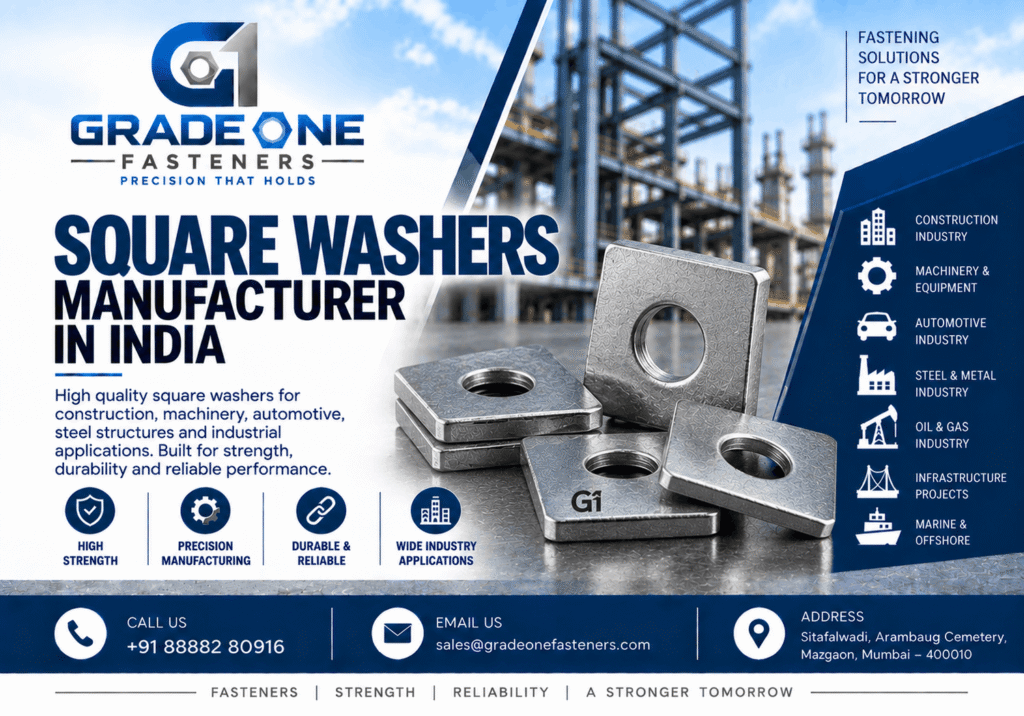
Grade One Fasteners is a trusted Square Washers Manufacturer in India, supplying high-quality square washers and square plate washers for construction, structural engineering, machinery, infrastructure and industrial fastening applications. Square washers are designed with a square outer profile and a central hole for accommodating bolts, screws, anchor bolts or other threaded fasteners. Compared with conventional round washers, square washers can provide a larger bearing area in suitable applications, helping distribute the load of a bolted connection over a wider surface. They are commonly used where additional surface coverage, load distribution and support are required, particularly in structural steelwork, construction assemblies, timber applications, heavy machinery and infrastructure projects. Square washers are available in different materials, dimensions, thicknesses and surface finishes depending on the application requirements. Square Washer Manufacturer and Supplier in India Grade One Fasteners supplies square washers for industrial customers requiring dependable fastening components for standard and project-specific applications. A washer may appear to be a simple component, but incorrect size, thickness or material selection can affect how the load is distributed across the joint. In applications involving softer materials, structural sections or large bolt assemblies, a larger washer bearing surface can help reduce concentrated pressure around the bolt hole. Our square washers can be supplied according to requirements involving: Square washers are widely available as standard and customised products for industrial and structural applications. What is a Square Washer? A square washer is a flat fastening component with a square outer shape and a centrally positioned hole. It is installed under a bolt head or nut to provide a wider bearing surface between the fastener and the connected material. The primary function of a square washer is to distribute the load generated by tightening the bolt or nut over a larger contact area. Square washers can be particularly useful in applications involving: The larger square profile can provide increased surface coverage compared with many conventional round washers, depending on the selected dimensions. How Square Washers Work A square washer works by creating an intermediate bearing surface between the fastener and the material being secured. When a bolt or nut is tightened: The actual performance of the joint depends on the complete fastening assembly, including bolt grade, preload, washer dimensions, material compatibility and the properties of the connected components. Square Washer Specifications Specification Available Options Product Square Washer Alternative Name Square Plate Washer Alternative Name Flat Square Washer Shape Square Hole Type Round Central Hole Material Mild Steel Material Carbon Steel Material Stainless Steel Material Alloy Steel Material High Tensile Steel Material Brass, Copper and Special Materials Finish Plain / Self Finish Finish Black Finish Zinc Plated Finish Hot Dip Galvanized Finish Mechanical Galvanized Finish PTFE and Special Coatings Size Range Standard and Custom Sizes Thickness As per Application Requirement Application Construction and Structural Applications Application Machinery and Industrial Fastening Customisation Available as per Drawing and Requirement The Square washers are commercially supplied in materials including mild steel, carbon steel, stainless steel and other engineering materials, with finishes such as black, zinc plated and hot-dip galvanized available depending on the supplier and application. Square Washer Size Chart The following sizes represent commonly used bolt-size ranges. Actual square dimensions, hole diameter and thickness should be selected according to the applicable standard or project requirement. Bolt Size Square Washer Availability M6 Available M8 Available M10 Available M12 Available M16 Available M20 Available M22 Available M24 Available M27 Available M30 Available M36 Available M42 Available M48 Available M52 and Above Available as per Requirement Commercial square washer ranges vary significantly depending on whether the product is manufactured to a standard series or as a customised plate washer. Suppliers also offer larger custom square dimensions for structural applications. Square Washer Dimensions Square washer dimensions are generally determined using the following measurements: Inner Diameter The inner diameter is the central hole through which the bolt or threaded fastener passes. Outer Side Length For square washers, the outer dimension is measured across each side of the square profile. Thickness Thickness is selected according to the required strength, load distribution and application. Hole Tolerance The hole size must provide suitable clearance for the intended bolt while maintaining the required bearing area around the opening. Surface Finish The selected finish should be appropriate for the operating environment and corrosion exposure. For standard square washer products, dimensions may be specified according to standards such as DIN 436 / ISO 7094 or other applicable standards depending on the washer configuration. Square Washer Material Grades Mild Steel Square Washers Mild steel square washers are commonly used in general construction, fabrication and industrial applications where standard strength and cost-effective fastening solutions are required. Carbon Steel Square Washers Carbon steel square washers are suitable for industrial and structural applications where stronger mechanical properties are required compared with certain general-purpose materials. Stainless Steel Square Washers Stainless steel square washers are selected where corrosion resistance is important. Common options include stainless steel grades such as SS 304 and SS 316 depending on the operating environment. Alloy Steel Square Washers Alloy steel square washers can be used for demanding engineering and high-strength applications where the material specification requires enhanced mechanical performance. Brass and Copper Square Washers Brass and copper square washers can be supplied for specialised applications involving electrical requirements, corrosion resistance or material compatibility. Special Alloy Square Washers Special materials may be required for chemical, marine, high-temperature and specialised industrial environments. Commercial square washer suppliers list options ranging from carbon and mild steel to stainless steel, alloy steel, brass, copper and specialised materials depending on the manufacturing requirement. Surface Finishes for Square Washers The correct surface finish depends on the operating environment and corrosion resistance requirement. Plain Finish Plain or self-finish washers are suitable where additional coating is not required. Black Finish Black-finished square washers are commonly used in industrial and mechanical applications. Zinc Plated Square Washers Zinc plating can provide additional corrosion protection for suitable environments. Hot Dip Galvanized Square Washers Hot dip galvanizing is commonly selected for outdoor, structural and infrastructure applications

Square Washers Manufacturer in India Read More »

Wedge Lock Washer Manufacturer and Supplier in India

Wedge Lock Washer Manufacturer in India

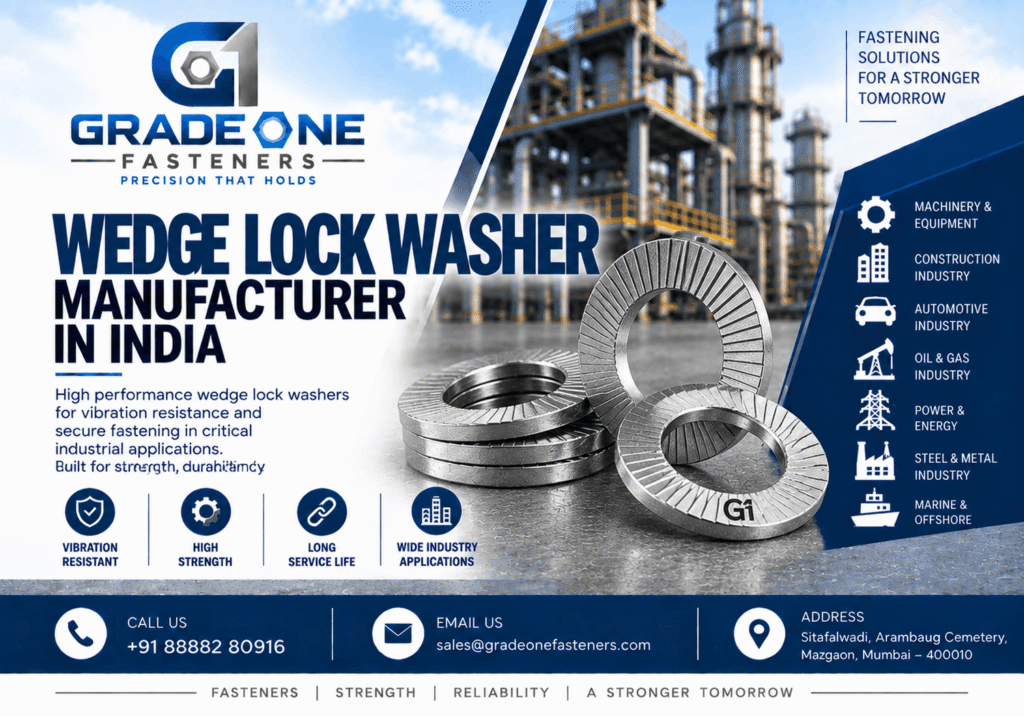
Grade One Fasteners is a Wedge Lock Washer Manufacturer in India supplying high-performance fastening solutions designed to help secure bolted joints exposed to vibration, dynamic loads and demanding industrial operating conditions. Wedge lock washers are widely used where maintaining bolt preload and reducing the risk of loosening is important for operational reliability. Our wedge locking washers are manufactured and supplied for applications across construction, heavy engineering, oil and gas, power generation, machinery, automotive, infrastructure, marine and other industrial sectors. Available materials, sizes and surface finishes can be selected according to application requirements and project specifications. What is a Wedge Lock Washer? A wedge lock washer is an anti-loosening fastening component generally supplied as a matched pair. The two washers work together to create a mechanical locking effect within a bolted joint. The inner surfaces of the washer pair contain cam faces, while the outer surfaces contain serrations designed to grip the contact surfaces. When the bolt or nut is tightened, the serrations engage with the mating surfaces. If rotational movement occurs due to vibration or dynamic loading, movement between the two washers occurs across the cam surfaces. The cam geometry is designed so that movement between the cams creates a wedge effect, helping maintain tension within the bolted connection and resisting loosening. This operating principle makes wedge lock washers suitable for applications exposed to severe vibration and dynamic loads. Wedge Lock Washer Manufacturer and Supplier in India Grade One Fasteners supplies wedge lock washers for customers requiring reliable anti-vibration fastening solutions. Industrial bolted joints can experience vibration, shock, thermal movement and repeated dynamic loading, all of which can affect the stability of conventional fastening assemblies. A properly selected wedge lock washer system helps improve the security of the bolted connection by using mechanical tension and cam action rather than relying only on friction. We can supply wedge locking washers for standard and project-specific requirements based on factors such as: How Wedge Lock Washers Work The working principle of a wedge lock washer is based on the interaction between the serrated outer surfaces and the cam surfaces positioned between the two washers. During tightening: This makes wedge locking washers particularly useful in applications where conventional washers may not provide sufficient protection against dynamic loosening. Wedge-locking systems are specifically designed for bolted joints exposed to severe vibration and dynamic loads. Types of Wedge Lock Washers Wedge lock washers can be supplied in different material and configuration options depending on the application. Stainless Steel Wedge Lock Washers Stainless steel wedge lock washers are commonly selected for applications requiring corrosion resistance. Grades such as SS 304 and SS 316 are used for industrial, marine, chemical and outdoor environments depending on project requirements. Carbon Steel Wedge Lock Washers Carbon steel wedge lock washers are suitable for many industrial and engineering applications. Protective coatings may be selected to improve corrosion resistance. Alloy Steel Wedge Lock Washers Alloy steel wedge locking washers can be considered for demanding applications where higher mechanical performance is required. Duplex and Special Alloy Wedge Lock Washers For highly corrosive or specialised industrial environments, wedge lock washers may also be manufactured or supplied in suitable corrosion-resistant alloys according to project requirements. Wedge Lock Washer Specifications Specification Available Options Product Wedge Lock Washer Alternative Name Wedge Locking Washer Alternative Name Cam Lock Washer Function Anti-Loosening and Vibration Resistance Supply Configuration Matched Pair Material Stainless Steel Material Carbon Steel Material Alloy Steel Special Materials Available as per requirement Surface Finish Plain Surface Finish Zinc Coated Surface Finish Zinc Flake Coated Surface Finish Passivated Surface Finish Special Coatings on Request Size Range As per bolt and project requirement Application High Vibration Bolted Joints Application Dynamic Load Applications Documentation Material and inspection documentation as required Common wedge-locking washer products are supplied as matched pairs, with material and dimensional ranges varying by manufacturer and application. DIN 25201 is commonly referenced for wedge-locking washer applications and product specifications. Wedge Lock Washer Size Chart The following table can be used as a general product-size reference. Final dimensions should always be confirmed according to the selected product specification and application requirement. Bolt Size Wedge Lock Washer Availability M3 Available M4 Available M5 Available M6 Available M8 Available M10 Available M12 Available M14 Available M16 Available M18 Available M20 Available M22 Available M24 Available M27 Available M30 and Above Available as per requirement Commercial suppliers offer different dimensional ranges, so exact outside diameter, inner diameter and assembled pair thickness should be confirmed against the required bolt size and specification. Wedge Lock Washer Material Grades Stainless Steel 304 SS 304 wedge lock washers are suitable for many industrial applications requiring good corrosion resistance and reliable mechanical performance. Stainless Steel 316 SS 316 wedge lock washers are commonly selected for environments where improved corrosion resistance is required, including marine and certain chemical or offshore applications. Carbon Steel Carbon steel wedge lock washers are suitable for general industrial applications. Coatings such as zinc flake may be used depending on corrosion exposure requirements. Alloy Steel Alloy steel options can be selected for applications involving demanding mechanical and operational conditions. Special Materials Special material grades may be considered for projects involving high temperatures, corrosive media or specialised industrial requirements. Standards for Wedge Lock Washers Wedge lock washers may be manufactured or specified according to applicable project and industry requirements. Commonly referenced standards include: The applicable standard should always be confirmed before procurement, especially for critical applications such as structural, offshore, power generation and heavy engineering projects. DIN 25201 is a widely referenced standard for wedge-locking washer geometry and performance. Applications of Wedge Lock Washers Wedge lock washers are used across industries where bolted connections are exposed to vibration, movement and dynamic loading. Construction Industry Construction machinery, structural assemblies, heavy equipment and infrastructure projects use reliable fastening systems to maintain bolted joint stability. Oil and Gas Industry Oil and gas equipment can operate under demanding vibration, pressure and environmental conditions. Wedge lock washers may be used in suitable bolted assemblies where vibration resistance and fastening reliability are

Wedge Lock Washer Manufacturer in India Read More »
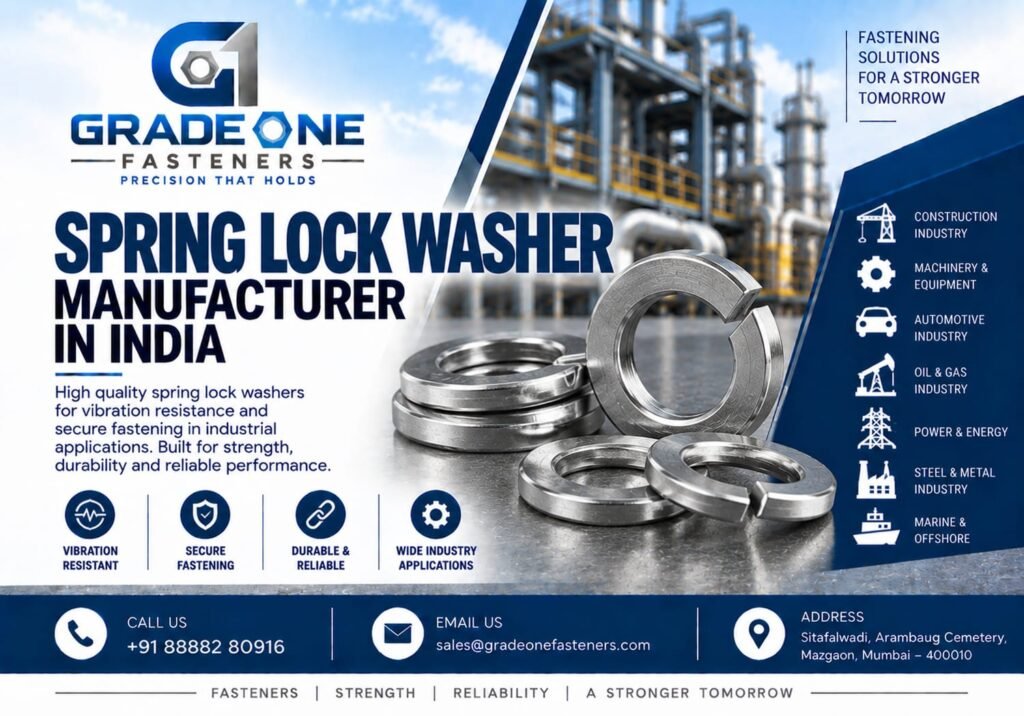
K Lock Nuts Manufacturer in India - Grade One Fasteners

K Lock Nuts Manufacturer in India

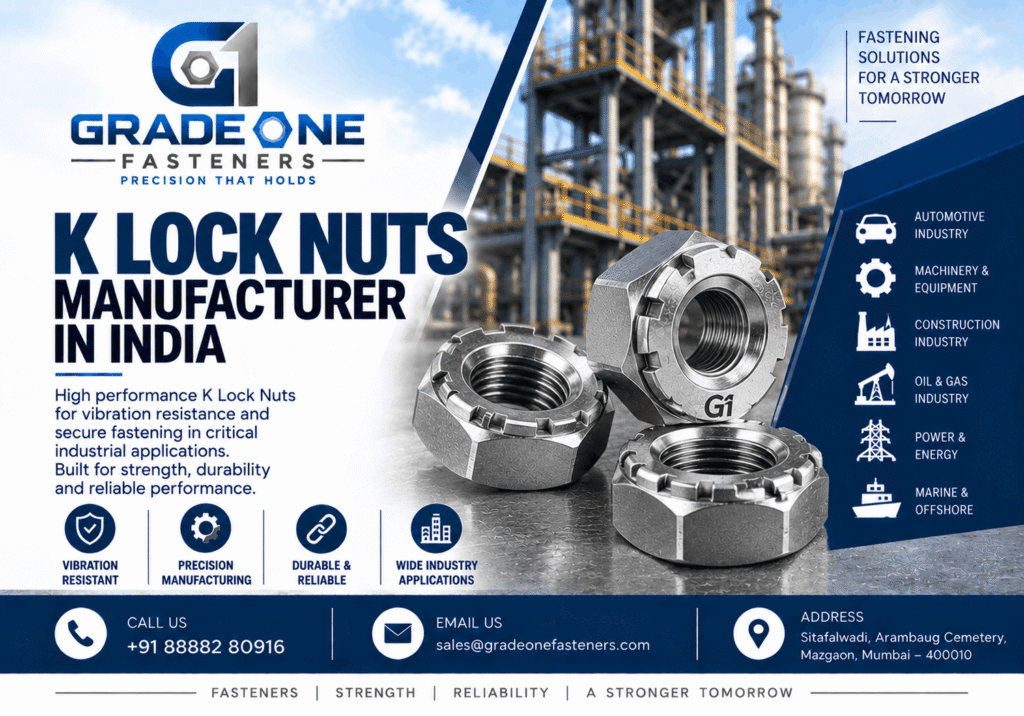
Grade One Fasteners is a trusted K Lock Nuts Manufacturer in India, supplying high-quality locking nuts designed for secure fastening applications where resistance to loosening, vibration and operational movement is important. K Lock Nuts are widely used in industrial assemblies where conventional nuts may loosen because of vibration, repeated movement or dynamic operating conditions. Their locking design provides additional resistance against unintended loosening and makes them suitable for machinery, automotive equipment, construction assemblies, engineering systems and other demanding applications. As an industrial K Lock Nuts Supplier in India, Grade One Fasteners supplies K Lock Nuts in different sizes, thread configurations, materials, grades and finishes according to customer requirements and application specifications. What Are K Lock Nuts? K Lock Nuts are a type of self-locking fastener designed to provide improved resistance against loosening during service. Unlike a standard nut that depends primarily on tightening force to maintain its position, a K Lock Nut incorporates a locking feature in its design. This creates additional resistance between the nut and mating threaded component. K Lock Nuts are commonly used with: The exact locking configuration can vary depending on the product design and required specification. Why Are K Lock Nuts Used? In industrial applications, vibration and repeated movement can affect conventional bolted joints. When a fastening assembly experiences continuous vibration, thermal movement or dynamic loading, maintaining secure clamping becomes an important consideration. K Lock Nuts are selected where additional resistance to loosening is required. Vibration Resistance K Lock Nuts provide additional locking resistance and are commonly used in applications exposed to vibration. Secure Fastening The locking feature helps improve the stability of the fastening assembly when correctly selected and installed. All-Metal Construction Options Many K Lock Nut designs are manufactured using all-metal locking features, making them suitable for applications where a non-metallic insert may not be appropriate. Reusable Design Depending on the product specification and application requirements, certain all-metal locking nuts can be removed and reinstalled. However, reuse should always be evaluated according to the applicable specification and project requirements. Suitable for Industrial Applications K Lock Nuts are used in demanding mechanical and industrial assemblies where secure fastening is required. K Lock Nuts Specifications Specification Available Options Product K Lock Nuts Product Type Self-Locking Nut Locking Feature All-Metal Locking Design Thread Type Metric, UNC, UNF and Custom Threads Material Carbon Steel, Stainless Steel, Alloy Steel and Special Materials Size Range Standard and Custom Sizes Surface Finish Self Finish, Zinc Plated, Black Oxide and Special Coatings Application Machinery, Automotive, Construction and Industrial Equipment Supply Type Standard and Customer-Specific Requirements The final specification should always be selected according to the mating fastener, operating conditions and application requirements. Types of K Lock Nuts K Lock Nuts can be supplied in different configurations depending on the required fastening application. Standard K Lock Nuts Standard K Lock Nuts are used in general industrial applications where additional resistance to loosening is required. Metric K Lock Nuts Metric K Lock Nuts are designed for metric threaded bolts and studs. Inch Size K Lock Nuts Inch-series K Lock Nuts can be supplied for UNC, UNF and other inch-thread applications. Stainless Steel K Lock Nuts Stainless Steel K Lock Nuts are selected for applications requiring improved corrosion resistance. Carbon Steel K Lock Nuts Carbon Steel K Lock Nuts are commonly used in general engineering, machinery and industrial applications. Alloy Steel K Lock Nuts Alloy Steel K Lock Nuts may be selected for applications requiring specific mechanical properties. Materials Available for K Lock Nuts The material selection plays an important role in the performance of the fastening assembly. Stainless Steel Stainless Steel K Lock Nuts are commonly selected for: Common grades can include stainless steel grades selected according to the required corrosion resistance and project specification. Carbon Steel Carbon Steel K Lock Nuts are widely used in industrial and general engineering applications. They can be supplied with different surface treatments depending on the required environmental protection. Alloy Steel Alloy Steel K Lock Nuts may be used where the fastening assembly requires specific mechanical properties. Special Materials For specialised industrial applications, K Lock Nuts can be considered in materials selected for: K Lock Nuts Size Range Thread Size Application Area M4 Light Industrial Assemblies M5 Equipment Components M6 Machinery Applications M8 Automotive and Industrial Equipment M10 Engineering Assemblies M12 Construction and Machinery M16 Heavy Industrial Applications M20 Engineering and Infrastructure M24 and Above Heavy-Duty Applications Inch Sizes Export and Special Applications The available size range can depend on the material, locking design and customer specification. Thread Types Available K Lock Nuts can be supplied with different thread configurations depending on the application. Metric Coarse Thread The Metric coarse threads are commonly used for general industrial applications. Metric Fine Thread Fine threads may be required for specific engineering applications. UNC Thread UNC threads are commonly used for inch-series fastening applications. UNF Thread UNF threads may be required where a fine inch-series thread is specified. Custom Threads Custom thread specifications can be considered based on drawings and technical requirements. K Lock Nuts Surface Finishes Surface Finish General Purpose Self Finish General Industrial Applications Zinc Plating Additional Corrosion Protection Black Oxide Machinery and Engineering Applications Zinc Flake Coating Enhanced Corrosion Resistance Special Coatings Project-Specific Requirements Custom Finish Customer Specifications The correct surface treatment should be selected according to the operating environment. How Do K Lock Nuts Work? K Lock Nuts are designed to create additional resistance against loosening when assembled with a compatible threaded fastener. During installation: The actual performance of a bolted joint depends on several factors, including: For critical applications, the complete fastening system should be selected according to engineering and project requirements. Applications of K Lock Nuts Automotive Industry K Lock Nuts can be used in automotive and vehicle-related assemblies exposed to movement and vibration. Applications may include: Machinery and Equipment Industrial machinery often operates with continuous movement and vibration. K Lock Nuts can be selected for: Construction Industry K Lock Nuts can be used in construction-related equipment and mechanical fastening assemblies. Oil and

K Lock Nuts Manufacturer in India Read More »

Hex Nuts Manufacturer in India - Grade One Fasteners

Hex Nuts Manufacturer in India

Grade One Fasteners is a trusted Hex Nuts Manufacturer in India, supplying precision-engineered industrial hex nuts for construction, machinery, automotive, infrastructure, oil and gas, power generation, metal fabrication and engineering applications. Hex Nuts are among the most widely used industrial fastening components. Their six-sided external shape allows tightening with standard tools, while the internal thread enables them to be used with compatible bolts, studs, threaded rods and other externally threaded fasteners. We supply Hex Nuts in different sizes, materials, thread configurations, property classes and surface finishes according to customer requirements, applicable standards and project specifications. What Are Hex Nuts? A Hex Nut is an internally threaded fastener with six external sides. It is designed to mate with a compatible bolt, stud or threaded rod to create a mechanical joint. When tightened correctly, the nut and mating fastener create clamping force that holds components together. The six-sided shape provides convenient wrench engagement during installation and removal. Hex Nuts are commonly referred to as: Standard metric Hex Nuts are commonly specified to standards such as ISO 4032 and DIN 934, while inch-series Hex Nuts may follow ASME B18.2.2, depending on the required application and specification. Why Are Hex Nuts Widely Used? Simple and Reliable Fastening Hex Nuts provide a straightforward fastening solution when used with compatible bolts and threaded components. Wide Size Availability Hex Nuts are available in metric and inch sizes for different industrial applications. Multiple Material Options Different materials can be selected depending on strength, corrosion resistance, temperature and environmental requirements. Easy Installation The six-sided design allows installation using common spanners, wrenches and industrial tightening equipment. Suitable for Multiple Industries Hex Nuts are used across machinery, construction, automotive, infrastructure, manufacturing and heavy engineering sectors. Types of Hex Nuts Standard Hex Nuts Standard Hex Nuts are general-purpose six-sided internally threaded nuts used with bolts, studs and threaded rods. Heavy Hex Nuts Heavy Hex Nuts have larger external dimensions than standard Hex Nuts and are commonly selected for heavy-duty and specialised applications. Fine Thread Hex Nuts Fine Thread Hex Nuts are supplied where the application requires a fine-pitch thread configuration. Stainless Steel Hex Nuts Stainless Steel Hex Nuts are suitable for applications requiring corrosion resistance. Carbon Steel Hex Nuts Carbon Steel Hex Nuts are widely used in general engineering and industrial applications. Alloy Steel Hex Nuts Alloy Steel Hex Nuts can be selected for applications requiring specific mechanical properties. High-Strength Hex Nuts High-strength Hex Nuts are manufactured or selected according to the required material grade, property class and applicable standard. Hex Nuts Specifications Specification Available Options Product Hex Nuts Alternative Names Hexagon Nuts, Standard Hex Nuts, Finished Hex Nuts Design Six-Sided Externally Threaded Fastener Thread Type Metric Coarse, Metric Fine, UNC, UNF and Custom Threads Material Carbon Steel, Mild Steel, Alloy Steel, Stainless Steel and Special Materials Sizes Standard and Custom Sizes Standards ISO 4032, DIN 934, ASME B18.2.2 and Customer Specifications Surface Finish Self Finish, Zinc Plated, Hot Dip Galvanized, Black Oxide and Special Coatings Application Construction, Machinery, Automotive, Engineering and Industrial Equipment ISO 4032 and DIN 934 are widely referenced for standard metric Hex Nuts, while ASME B18.2.2 covers commonly used inch-series Hex Nut dimensions. Hex Nuts Materials Stainless Steel Hex Nuts Stainless Steel Hex Nuts are commonly selected for applications where corrosion resistance is important. Suitable applications may include: Common stainless steel grades may include 304 and 316, depending on project requirements. Carbon Steel Hex Nuts Carbon Steel Hex Nuts are widely used in machinery, construction and general engineering applications. Different grades and coatings can be selected based on the required mechanical and environmental performance. Mild Steel Hex Nuts Mild Steel Hex Nuts can be used for general fabrication and industrial fastening applications where the required mechanical properties are appropriate. Alloy Steel Hex Nuts Alloy Steel Hex Nuts can be supplied for applications requiring higher mechanical performance or project-specific material specifications. Special Material Hex Nuts For demanding industrial applications, Hex Nuts may also be manufactured from specialised materials selected for corrosion resistance, high-temperature service or chemical resistance. Hex Nuts Size Range Thread Size Thread System Typical Application M4 Metric Light Industrial Assemblies M5 Metric Equipment and Components M6 Metric Machinery and Engineering M8 Metric Automotive and Equipment M10 Metric Industrial Applications M12 Metric Construction and Machinery M16 Metric Heavy Industrial Applications M20 Metric Engineering and Infrastructure M24 and Above Metric Heavy-Duty Applications Inch Sizes UNC / UNF Export and Special Applications The exact dimensions should always be selected according to the applicable standard, drawing and project specification. Manufacturers commonly offer Hex Nuts across both metric and inch ranges, with ISO/DIN and ASME standards depending on the thread system. Hex Nuts Standards Hex Nuts can be manufactured according to different international standards depending on the application. Common standards include: The correct standard should be confirmed before placing an order because dimensional and material requirements vary depending on the application. Hex Nuts Applications Construction Industry Hex Nuts are used in construction assemblies, fabricated structures, equipment and mechanical connections. Machinery and Equipment Industrial machinery uses Hex Nuts with bolts, studs and threaded rods for assembling components. Automotive Industry Hex Nuts are used across vehicle components, machinery and automotive equipment. Oil and Gas Industry Oil and gas applications may require specific materials, grades, standards and documentation depending on the project. Infrastructure Projects Infrastructure applications can require Hex Nuts for equipment installation, fabricated steelwork and mechanical assemblies. Power Generation Industrial equipment used in power generation may require specialised fasteners selected according to operating conditions. Steel and Metal Industry Hex Nuts are widely used in fabricated steel assemblies, machinery and industrial equipment. Engineering Industry Engineering applications use Hex Nuts for assembling mechanical systems and fastening threaded components. Hex Nuts Manufacturing Process Raw Material Selection Suitable raw material is selected according to the required material specification and mechanical requirements. Forming or Machining Depending on the product size, material and manufacturing requirement, Hex Nuts may be produced through: Threading The internal thread is manufactured according to the specified metric, UNC, UNF or other required thread system.

Hex Nuts Manufacturer in India Read More »
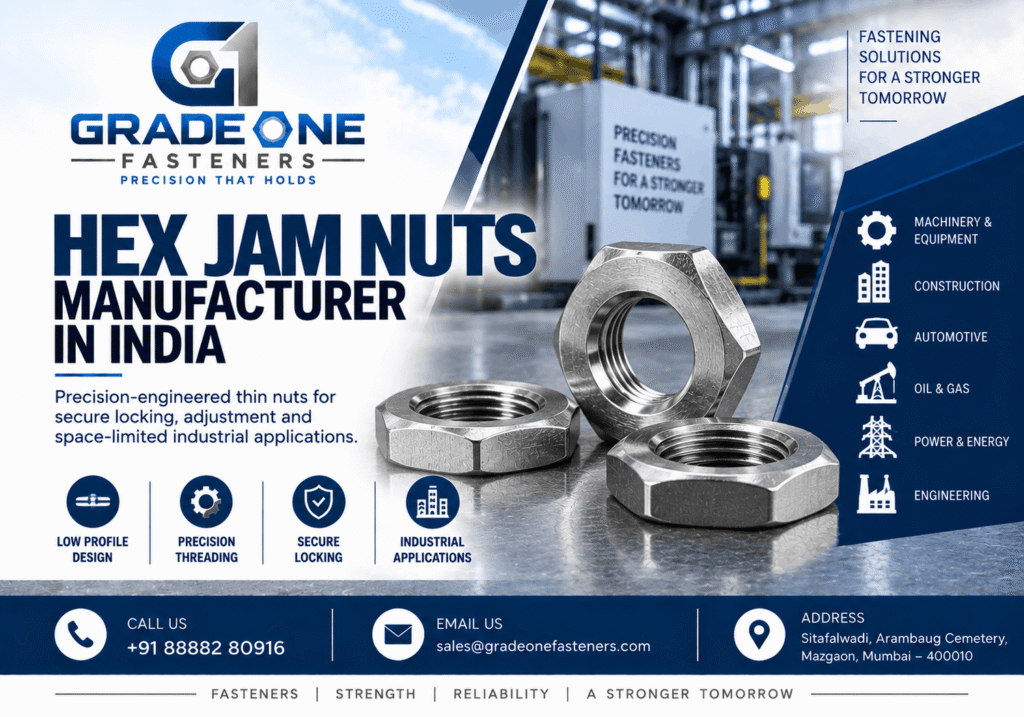
Hex Jam Nuts Manufacturer in India - Grade One Fasteners

Hex Jam Nuts Manufacturer in India

Grade One Fasteners is a reliable Hex Jam Nuts Manufacturer in India, supplying precision-engineered thin nuts for machinery, construction, engineering, automotive, infrastructure and industrial fastening applications. Hex Jam Nuts are low-profile hexagonal nuts commonly used where limited installation space is available or where a secondary nut is used to help secure and lock an assembly. Compared with standard hex nuts, jam nuts have a reduced thickness while maintaining a hexagonal shape and compatible thread configuration. We manufacture and supply Hex Jam Nuts in different sizes, materials, thread types, grades and surface finishes according to customer drawings, project specifications and industrial application requirements. What Are Hex Jam Nuts? A Hex Jam Nut is a thin hexagonal internally threaded nut. It is commonly used together with another nut in a double-nut arrangement or where a reduced-height fastening component is required. The low-profile design makes Hex Jam Nuts useful in applications where a standard-height nut may not fit due to space restrictions. When used as part of a double-nut assembly, the jam nut is tightened against the primary nut to help resist loosening under suitable service conditions. Hex Jam Nuts are also known as: Metric thin jam nuts are commonly associated with standards such as DIN 439 and ISO 4035, while inch-series dimensions may follow ASME B18.2.2 requirements depending on the product specification. Why Are Hex Jam Nuts Used? Hex Jam Nuts are selected primarily for two important requirements: space efficiency and locking arrangements. Low-Profile Fastening A Hex Jam Nut has a reduced height compared with a standard hex nut. This makes it suitable for assemblies where vertical clearance is limited. Double-Nut Locking A jam nut may be used together with a standard nut. The two nuts are tightened against each other to create a locking arrangement suitable for the specific assembly design. Adjustment Applications Hex Jam Nuts can be used in adjustable threaded assemblies where the position of a component must be set and then secured. Industrial Equipment Machinery and engineering systems often require thin fastening components where standard nuts would occupy excessive space. Types of Hex Jam Nuts Standard Hex Jam Nuts Standard Hex Jam Nuts are thin-profile nuts manufactured for general industrial fastening and locking arrangements. Metric Hex Jam Nuts Metric Hex Jam Nuts are available with metric thread sizes and may be manufactured according to applicable dimensional standards. Inch Hex Jam Nuts Inch-series Hex Jam Nuts can be supplied with UNC, UNF or other specified thread configurations. Fine Thread Hex Jam Nuts Fine thread configurations are available for applications requiring specific thread engagement and adjustment characteristics. Stainless Steel Hex Jam Nuts Stainless Steel Hex Jam Nuts are suitable for applications requiring corrosion resistance, depending on the material grade and operating environment. Carbon Steel Hex Jam Nuts Carbon Steel Hex Jam Nuts are widely used in general engineering, machinery and industrial applications. Alloy Steel Hex Jam Nuts Alloy Steel Hex Jam Nuts are selected for demanding applications requiring specific mechanical properties. Hex Jam Nuts Specifications Specification Available Options Product Hex Jam Nuts Alternative Name Thin Hex Nuts / Half Nuts Design Low Profile Hexagonal Thread Type Metric / UNC / UNF / Fine Thread / Custom Material Carbon Steel, Mild Steel, Alloy Steel, Stainless Steel and Special Materials Sizes Standard and Custom Sizes Standards DIN 439, ISO 4035, ASME B18.2.2 and customer specifications Surface Finish Self Finish, Zinc Plated, Hot Dip Galvanized, Black Oxide and other finishes Manufacturing Cold Forming, Hot Forging or Machining Application Machinery, Construction, Automotive, Engineering and Industrial Equipment Hex Jam Nuts are generally thinner than standard hex nuts. DIN 439 is commonly referenced for metric thin hex jam nuts, while ASME B18.2.2 is commonly referenced for inch-series hex jam nut dimensions. Hex Jam Nuts Materials Stainless Steel Stainless Steel Hex Jam Nuts are selected for applications where corrosion resistance is important. Depending on the requirement, suitable stainless steel grades may be selected for: Carbon Steel Carbon Steel Hex Jam Nuts are widely used in industrial and engineering applications. Suitable surface coatings may be applied where additional corrosion protection is required. Mild Steel Mild Steel Hex Jam Nuts can be used in general fabrication and industrial fastening applications where the required mechanical properties are appropriate. Alloy Steel Alloy Steel Hex Jam Nuts are selected for applications involving demanding mechanical conditions and specific project requirements. Special Materials For specialised applications, Hex Jam Nuts may also be manufactured from materials selected for corrosion resistance, high temperature service or other demanding environmental conditions. Hex Jam Nuts Size Range Thread Size Thread System Typical Application M4 Metric Light Industrial Assemblies M5 Metric Equipment and Components M6 Metric Machinery Assemblies M8 Metric Automotive and Engineering M10 Metric Industrial Equipment M12 Metric Construction and Machinery M16 Metric Heavy Industrial Applications M20 and Above Metric Heavy Duty Applications Inch Sizes UNC / UNF Export and Special Applications The exact width across flats, thickness, thread pitch and other dimensions should be selected according to the required standard, drawing or project specification. Hex Jam Nuts Standards Hex Jam Nuts can be manufactured according to different international standards depending on whether metric or inch-series dimensions are required. Common standards include: DIN 439 is commonly associated with thin metric hex nuts, while ASME B18.2.2 includes dimensional requirements for hex flat jam nuts in inch-series applications. Before ordering, customers should confirm the required standard rather than assuming that all products described as “Hex Jam Nuts” have identical dimensions. Hex Jam Nuts Applications Machinery and Equipment Hex Jam Nuts are commonly used in machinery where a low-profile fastening solution or locking arrangement is required. Construction Industry Construction equipment and fabricated assemblies may use jam nuts in threaded adjustment and fastening systems. Automotive Industry Automotive and vehicle-related assemblies may use thin nuts where space restrictions or specific locking arrangements apply. Engineering Applications Engineering systems frequently use Hex Jam Nuts for adjustment mechanisms, threaded rods and precision assemblies. Infrastructure Projects Jam nuts may be used in suitable structural and equipment assemblies based on project requirements. Oil and Gas Industry Special material

Hex Jam Nuts Manufacturer in India Read More »
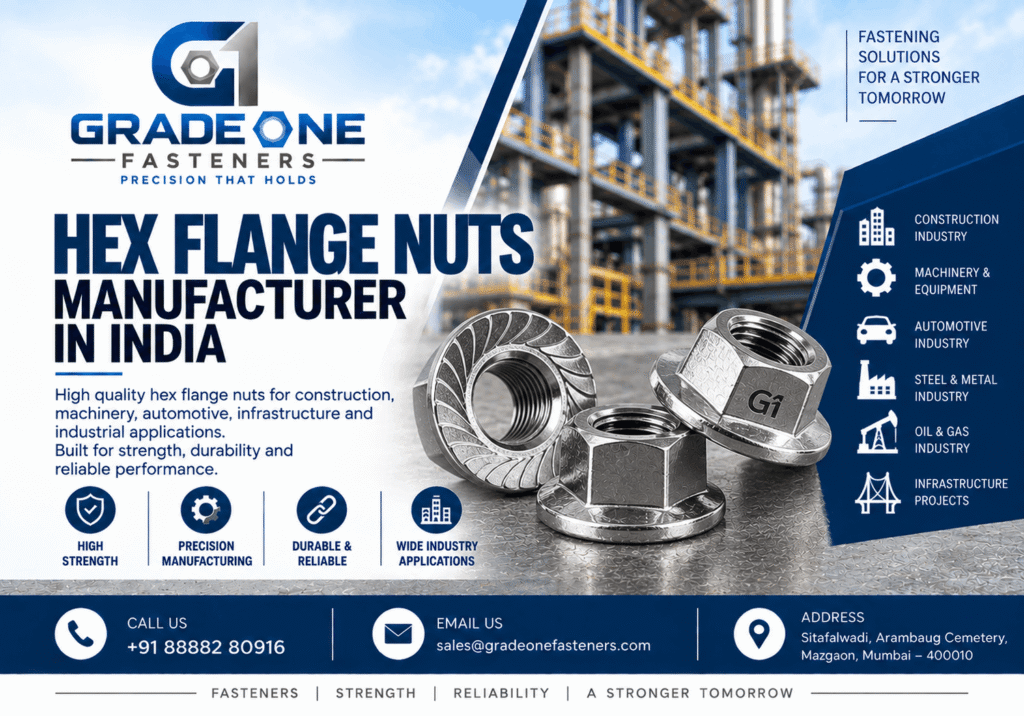
Hex Flange Nuts Manufacturer in India - Grade One Fasteners

Hex Flange Nuts Manufacturer in India

Grade One Fasteners is a reliable Hex Flange Nuts Manufacturer in India, supplying precision-engineered fastening solutions for construction, machinery, automotive, infrastructure, engineering and industrial applications. Our Hex Flange Nuts are designed with an integrated flange that provides a larger bearing surface and helps distribute the fastening load more effectively. A Hex Flange Nut combines the functionality of a conventional hex nut with a washer-like flange. This design can reduce the requirement for a separate washer in suitable assemblies and provides a stable fastening surface. Depending on the application, Hex Flange Nuts may be supplied in standard or serrated flange configurations. We manufacture and supply Hex Flange Nuts in different sizes, materials, thread configurations, grades and surface finishes according to customer and application requirements. What Are Hex Flange Nuts? A Hex Flange Nut is a hexagonal internally threaded fastener with an integrated circular flange at its base. The flange increases the contact area between the nut and the component being fastened. The main purpose of the flange is to distribute the clamping load over a larger surface area. This makes Hex Flange Nuts suitable for assemblies involving machinery, fabricated structures, automotive components and industrial equipment. Compared with a standard nut and separate washer combination, a flange nut provides an integrated fastening design. The correct selection of a Hex Flange Nut depends on factors such as load requirements, vibration, material compatibility, thread type, environmental conditions and applicable project specifications. Types of Hex Flange Nuts Standard Hex Flange Nuts Standard Hex Flange Nuts feature a smooth flange surface. They are commonly used where load distribution and a larger bearing surface are required without additional locking serrations. Serrated Hex Flange Nuts Serrated Hex Flange Nuts have serrations on the underside of the flange. In suitable applications, these serrations can increase resistance to rotational movement after installation. The suitability of serrated flange nuts should always be evaluated based on the mating surface and application requirements. Metric Hex Flange Nuts Metric Hex Flange Nuts are manufactured with metric thread systems and can be supplied in different diameters and pitch configurations according to applicable standards and customer requirements. Stainless Steel Hex Flange Nuts Stainless Steel Hex Flange Nuts are selected for applications requiring corrosion resistance and durability in demanding environments. Common industrial material options may include stainless steel grades selected according to the required mechanical and environmental performance. Carbon Steel and Alloy Steel Hex Flange Nuts Carbon Steel and Alloy Steel Hex Flange Nuts are commonly used for industrial applications where strength and mechanical performance are important. Material and property class selection should be matched with the bolt or threaded component used in the assembly. Hex Flange Nuts Specifications Specification Available Options Product Hex Flange Nuts Design Standard Flange / Serrated Flange Thread Type Metric / Inch / Custom Thread Material Carbon Steel, Mild Steel, Alloy Steel, Stainless Steel and other materials as required Sizes Standard and custom sizes as per requirement Grades Different mechanical grades and property classes as required Surface Finish Self Finish, Zinc Plated, Hot Dip Galvanized, Black Oxide and other finishes Manufacturing Cold Forming, Hot Forging or Machining depending on size and material Application Construction, Automotive, Machinery, Infrastructure, Engineering and Industrial Equipment Supply Manufacturer and Supplier in India Hex Flange Nut Materials Material selection plays an important role in the performance and service life of industrial fasteners. Stainless Steel Stainless Steel Hex Flange Nuts are commonly selected for applications where corrosion resistance is important. They may be used in chemical processing, marine environments, food equipment, water systems and outdoor industrial installations depending on the grade selected. Carbon Steel Carbon Steel Hex Flange Nuts are widely used in general industrial and engineering applications. They can be supplied with suitable coatings or finishes based on corrosion protection requirements. Mild Steel Mild Steel Hex Flange Nuts can be used in general fabrication, structural assemblies and industrial equipment where application conditions allow. Alloy Steel Alloy Steel Hex Flange Nuts are selected for applications requiring higher mechanical strength and demanding operating performance. Special Materials For specialised industrial requirements, Hex Flange Nuts may also be manufactured using materials selected for high temperature, corrosion resistance, chemical exposure or other project-specific operating conditions. Hex Flange Nuts Size Chart Thread Size Thread System Typical Application M5 Metric Light Industrial Assemblies M6 Metric Machinery and Equipment M8 Metric Automotive and Engineering M10 Metric Industrial Machinery M12 Metric Construction and Structural Equipment M16 Metric Heavy Industrial Applications M20 and Above Metric Heavy Duty and Custom Applications Inch Sizes UNC / UNF / Other Export and Special Requirement Applications Actual dimensions, flange diameter, nut height, width across flats and thread requirements should be selected according to the applicable drawing or required standard. Hex Flange Nuts Standards Hex Flange Nuts can be manufactured or supplied according to applicable international and project-specific standards. Common references in the industry include DIN 6923, ISO 4161 and JIS B1190, depending on the product design and customer requirement. BIS also lists IS 15581:2018 for hexagon nuts with flange, style 2, coarse thread. For project-specific requirements, Grade One Fasteners can review the required dimensions, material, thread configuration, mechanical requirements and finish before supply. Why Use Hex Flange Nuts? Hex Flange Nuts offer several advantages in suitable fastening applications. Larger Bearing Surface The integrated flange increases the contact area between the nut and the assembled component. This helps distribute the fastening load over a wider surface. Reduced Requirement for Separate Washers In suitable assemblies, the integrated flange can eliminate the need for a separate washer, simplifying the fastening arrangement. Faster Assembly Using a nut with an integrated flange can reduce the number of individual components handled during assembly. Reliable Industrial Fastening When correctly specified and installed, Hex Flange Nuts provide a practical fastening solution for industrial, engineering and machinery applications. Available in Different Materials and Finishes Hex Flange Nuts can be selected according to environmental conditions, strength requirements and industry specifications. Hex Flange Nuts Applications Construction Industry Hex Flange Nuts are used in fabricated structures, construction machinery, equipment installations and other fastening

Hex Flange Nuts Manufacturer in India Read More »
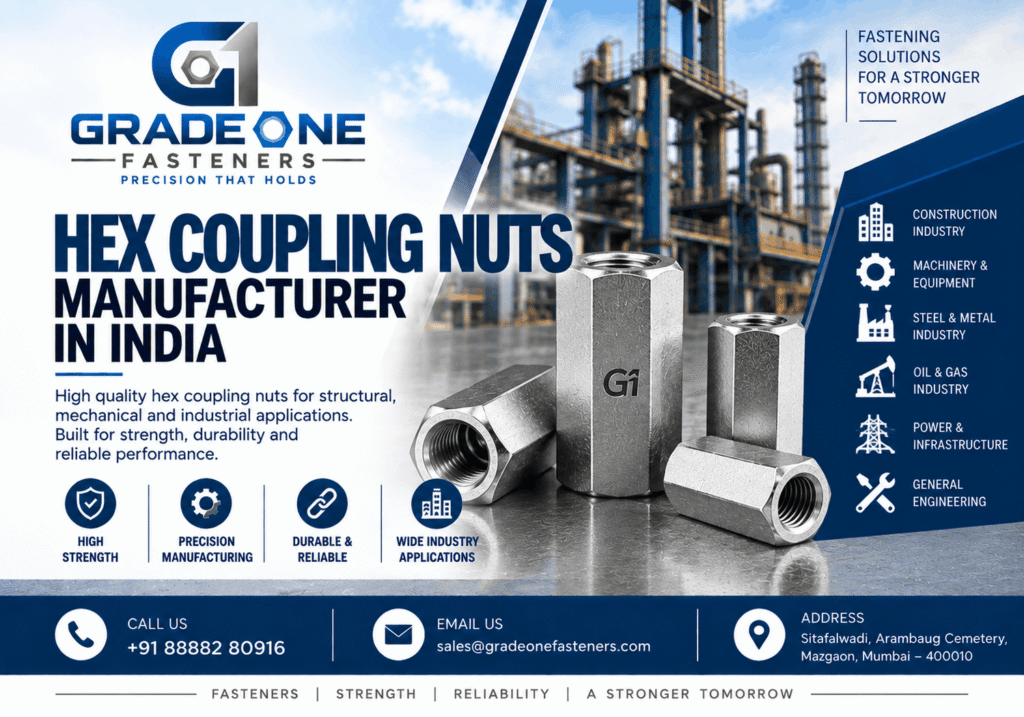
Hex Coupling Nuts Manufacturer and Supplier in India

Hex Coupling Nuts Manufacturer & Supplier in India

Grade One Fasteners is a reliable Hex Coupling Nuts Manufacturer and Supplier in India, providing precision-engineered fastening solutions for construction, structural engineering, machinery, infrastructure, oil and gas, power generation and other industrial applications. Hex coupling nuts are elongated internally threaded fasteners designed primarily to connect two externally threaded components. They are commonly used for joining threaded rods, extending threaded connections, connecting studs and creating secure mechanical assemblies where a standard hex nut does not provide sufficient thread engagement. The extended body of a coupling nut provides a larger threaded engagement area than a regular nut. This makes it particularly useful for applications involving threaded rod extension, structural support systems, tension assemblies, suspended installations and industrial equipment. Grade One Fasteners supplies Hex Coupling Nuts in a wide range of sizes, materials, thread configurations and surface finishes according to customer requirements and applicable standards. What Are Hex Coupling Nuts? A Hex Coupling Nut is a long hexagonal nut with internal threads running through its body. Its primary purpose is to join two threaded components together. For example, when two threaded rods need to be connected end-to-end, a coupling nut can be installed over both threaded ends to create an extended connection. The hexagonal external profile allows the nut to be tightened and installed using standard spanners or wrenches. The elongated body provides increased thread engagement, helping distribute the load across a longer threaded section. Hex coupling nuts are also known as: The exact terminology may vary depending on the industry, application or customer specification. Hex Coupling Nuts Manufacturer in India for Industrial Applications Selecting the correct Hex Coupling Nut is important because the product must be compatible with the connected threaded components. The following factors generally need to match the application: Grade One Fasteners focuses on supplying coupling nuts suitable for industrial and engineering applications where dimensional accuracy and proper thread engagement are important. Hex coupling nuts can be manufactured or supplied in metric and imperial thread configurations depending on the customer’s requirements. Common thread configurations may include: How Do Hex Coupling Nuts Work? A Hex Coupling Nut works by internally connecting two externally threaded components. One threaded rod or stud is inserted into one side of the coupling nut. The second threaded component is inserted into the opposite side. Once properly installed, the coupling nut creates a continuous threaded connection between the two components. This design is particularly useful when a longer threaded connection is required but a single threaded rod of the required length is not practical. Proper installation is important to ensure adequate thread engagement on both sides of the coupling nut. The final performance of the assembly depends on several factors, including: For critical applications, the final design and product specification should be selected according to the applicable engineering requirements. Advantages of Hex Coupling Nuts Extended Thread Connection The main advantage of a coupling nut is its ability to connect two threaded components and create a longer assembly. This makes it useful for extending threaded rods and structural fastening systems. Increased Thread Engagement Because coupling nuts have an elongated body, they can provide greater internal thread engagement compared with standard nuts. Proper thread engagement helps create a secure mechanical connection when the correct product is selected and installed. Easy Installation The external hexagonal shape allows the product to be tightened using commonly available tools. This makes installation convenient for industrial, structural and maintenance applications. Multiple Material Options Hex coupling nuts can be supplied in different materials depending on the required mechanical properties and environmental conditions. Custom Manufacturing Possibilities Depending on the order requirement, coupling nuts may be produced with custom lengths, thread combinations, dimensions and material specifications. Hex Coupling Nuts Specifications Specification Available Options Product Type Hex Coupling Nuts Alternative Names Extension Nuts, Rod Couplers, Long Hex Nuts Body Shape Hexagonal Thread Type Internal Thread Metric Threads Metric Coarse and Metric Fine Imperial Threads UNC, UNF and other required configurations Material Options Carbon Steel, Mild Steel, Alloy Steel, Stainless Steel and Special Alloys Stainless Steel Grades SS 304, SS 304L, SS 316, SS 316L and other grades as required Alloy Materials Alloy Steel and application-specific alloy materials Special Materials Inconel, Monel, Hastelloy, Duplex and Super Duplex as required Finish Options Plain, Zinc Plated, Black Oxide, Hot Dip Galvanized and other finishes Manufacturing Machined, Forged or customer-specific production process Standard Configuration As per applicable DIN, ISO, ASME or customer requirements Customization Available as per drawing and application requirements Common industry references for coupling nuts include DIN 6334 and, for certain inch-series/general application configurations, ASME B18.2.2. The exact governing standard should always be matched to the ordered product rather than assumed from the product name alone. Available Materials for Hex Coupling Nuts Stainless Steel Hex Coupling Nuts Stainless steel coupling nuts are suitable for applications where corrosion resistance is important. Common material options may include: The selection of stainless steel depends on the operating environment, chemical exposure, temperature and application requirements. Stainless steel coupling nuts are commonly used in: Carbon Steel Hex Coupling Nuts Carbon steel coupling nuts are commonly used for general engineering, structural and industrial applications. They can provide a practical combination of strength and cost depending on the required grade and application. Carbon steel coupling nuts may be supplied with protective finishes when additional corrosion resistance is required. Mild Steel Hex Coupling Nuts Mild steel coupling nuts are suitable for general-purpose fastening and fabrication applications where extremely high strength or corrosion resistance is not the primary requirement. Alloy Steel Hex Coupling Nuts Alloy steel coupling nuts can be selected for applications requiring higher mechanical performance. The material and grade should be matched with the corresponding threaded rod, stud or bolt to ensure compatibility with the intended application. Special Alloy Hex Coupling Nuts For demanding industrial environments, coupling nuts may also be required in special materials such as: Special alloy coupling nuts are generally selected where corrosion resistance, elevated-temperature performance or chemical compatibility is critical. Hex Coupling Nuts Size and Thread Options Grade One Fasteners can supply

Hex Coupling Nuts Manufacturer & Supplier in India Read More »