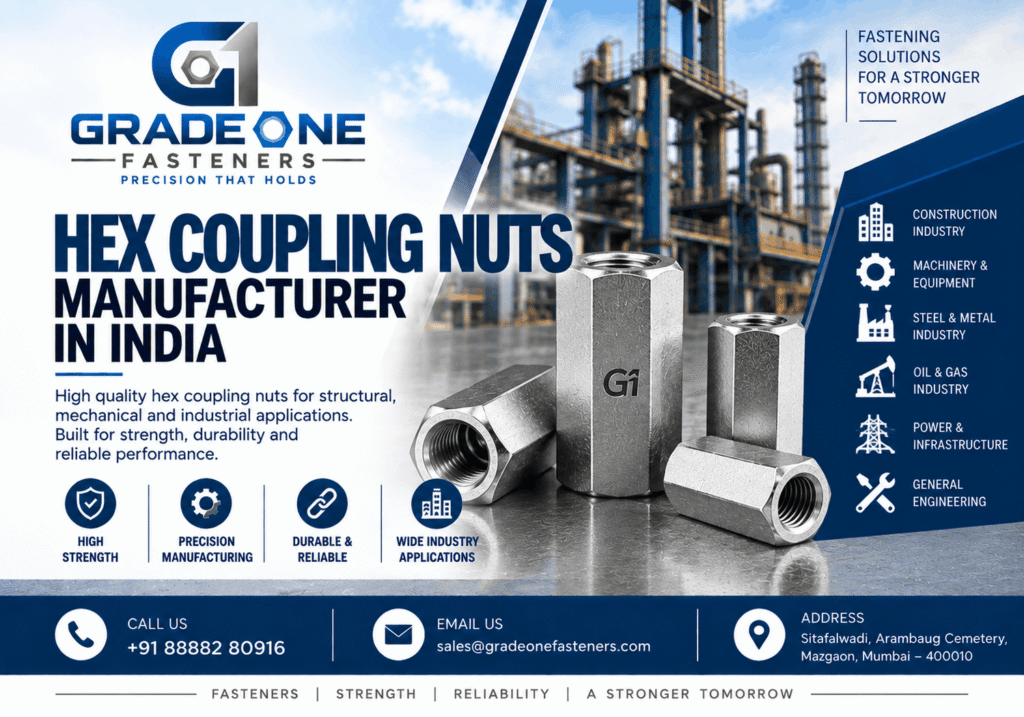
Grade One Fasteners is a reliable Hex Coupling Nuts Manufacturer and Supplier in India, providing precision-engineered fastening solutions for construction, structural engineering, machinery, infrastructure, oil and gas, power generation and other industrial applications.
Hex coupling nuts are elongated internally threaded fasteners designed primarily to connect two externally threaded components. They are commonly used for joining threaded rods, extending threaded connections, connecting studs and creating secure mechanical assemblies where a standard hex nut does not provide sufficient thread engagement.
The extended body of a coupling nut provides a larger threaded engagement area than a regular nut. This makes it particularly useful for applications involving threaded rod extension, structural support systems, tension assemblies, suspended installations and industrial equipment.
Grade One Fasteners supplies Hex Coupling Nuts in a wide range of sizes, materials, thread configurations and surface finishes according to customer requirements and applicable standards.
What Are Hex Coupling Nuts?
A Hex Coupling Nut is a long hexagonal nut with internal threads running through its body. Its primary purpose is to join two threaded components together.
For example, when two threaded rods need to be connected end-to-end, a coupling nut can be installed over both threaded ends to create an extended connection.
The hexagonal external profile allows the nut to be tightened and installed using standard spanners or wrenches. The elongated body provides increased thread engagement, helping distribute the load across a longer threaded section.
Hex coupling nuts are also known as:
- Coupling Nuts
- Hex Coupling Nuts
- Extension Nuts
- Rod Couplers
- Threaded Rod Connectors
- Long Hex Nuts
The exact terminology may vary depending on the industry, application or customer specification.
Hex Coupling Nuts Manufacturer in India for Industrial Applications
Selecting the correct Hex Coupling Nut is important because the product must be compatible with the connected threaded components.
The following factors generally need to match the application:
- Thread diameter
- Thread pitch
- Thread type
- Material grade
- Strength requirement
- Coupling nut length
- Environmental conditions
- Corrosion resistance requirement
- Applicable standard
- Surface finish
Grade One Fasteners focuses on supplying coupling nuts suitable for industrial and engineering applications where dimensional accuracy and proper thread engagement are important.
Hex coupling nuts can be manufactured or supplied in metric and imperial thread configurations depending on the customer’s requirements.
Common thread configurations may include:
- Metric Coarse Thread
- Metric Fine Thread
- UNC Thread
- UNF Thread
- BSW Thread
- Custom Thread Configurations
How Do Hex Coupling Nuts Work?
A Hex Coupling Nut works by internally connecting two externally threaded components.
One threaded rod or stud is inserted into one side of the coupling nut. The second threaded component is inserted into the opposite side.
Once properly installed, the coupling nut creates a continuous threaded connection between the two components.
This design is particularly useful when a longer threaded connection is required but a single threaded rod of the required length is not practical.
Proper installation is important to ensure adequate thread engagement on both sides of the coupling nut.
The final performance of the assembly depends on several factors, including:
- Thread compatibility
- Engagement length
- Material compatibility
- Applied load
- Installation torque
- Alignment
- Environmental conditions
For critical applications, the final design and product specification should be selected according to the applicable engineering requirements.
Advantages of Hex Coupling Nuts
Extended Thread Connection
The main advantage of a coupling nut is its ability to connect two threaded components and create a longer assembly.
This makes it useful for extending threaded rods and structural fastening systems.
Increased Thread Engagement
Because coupling nuts have an elongated body, they can provide greater internal thread engagement compared with standard nuts.
Proper thread engagement helps create a secure mechanical connection when the correct product is selected and installed.
Easy Installation
The external hexagonal shape allows the product to be tightened using commonly available tools.
This makes installation convenient for industrial, structural and maintenance applications.
Multiple Material Options
Hex coupling nuts can be supplied in different materials depending on the required mechanical properties and environmental conditions.
Custom Manufacturing Possibilities
Depending on the order requirement, coupling nuts may be produced with custom lengths, thread combinations, dimensions and material specifications.
Hex Coupling Nuts Specifications
| Specification | Available Options |
|---|---|
| Product Type | Hex Coupling Nuts |
| Alternative Names | Extension Nuts, Rod Couplers, Long Hex Nuts |
| Body Shape | Hexagonal |
| Thread Type | Internal Thread |
| Metric Threads | Metric Coarse and Metric Fine |
| Imperial Threads | UNC, UNF and other required configurations |
| Material Options | Carbon Steel, Mild Steel, Alloy Steel, Stainless Steel and Special Alloys |
| Stainless Steel Grades | SS 304, SS 304L, SS 316, SS 316L and other grades as required |
| Alloy Materials | Alloy Steel and application-specific alloy materials |
| Special Materials | Inconel, Monel, Hastelloy, Duplex and Super Duplex as required |
| Finish Options | Plain, Zinc Plated, Black Oxide, Hot Dip Galvanized and other finishes |
| Manufacturing | Machined, Forged or customer-specific production process |
| Standard Configuration | As per applicable DIN, ISO, ASME or customer requirements |
| Customization | Available as per drawing and application requirements |
Common industry references for coupling nuts include DIN 6334 and, for certain inch-series/general application configurations, ASME B18.2.2. The exact governing standard should always be matched to the ordered product rather than assumed from the product name alone.
Available Materials for Hex Coupling Nuts
Stainless Steel Hex Coupling Nuts
Stainless steel coupling nuts are suitable for applications where corrosion resistance is important.
Common material options may include:
- Stainless Steel 304
- Stainless Steel 304L
- Stainless Steel 316
- Stainless Steel 316L
The selection of stainless steel depends on the operating environment, chemical exposure, temperature and application requirements.
Stainless steel coupling nuts are commonly used in:
- Marine applications
- Chemical processing
- Food processing equipment
- Pharmaceutical equipment
- Water treatment systems
- Outdoor installations
Carbon Steel Hex Coupling Nuts
Carbon steel coupling nuts are commonly used for general engineering, structural and industrial applications.
They can provide a practical combination of strength and cost depending on the required grade and application.
Carbon steel coupling nuts may be supplied with protective finishes when additional corrosion resistance is required.
Mild Steel Hex Coupling Nuts
Mild steel coupling nuts are suitable for general-purpose fastening and fabrication applications where extremely high strength or corrosion resistance is not the primary requirement.
Alloy Steel Hex Coupling Nuts
Alloy steel coupling nuts can be selected for applications requiring higher mechanical performance.
The material and grade should be matched with the corresponding threaded rod, stud or bolt to ensure compatibility with the intended application.
Special Alloy Hex Coupling Nuts
For demanding industrial environments, coupling nuts may also be required in special materials such as:
- Inconel
- Monel
- Hastelloy
- Duplex Steel
- Super Duplex Steel
- Nickel Alloys
Special alloy coupling nuts are generally selected where corrosion resistance, elevated-temperature performance or chemical compatibility is critical.
Hex Coupling Nuts Size and Thread Options
Grade One Fasteners can supply Hex Coupling Nuts according to the required thread size and application.
Available dimensions can vary depending on:
- Material
- Manufacturing method
- Standard
- Thread type
- Customer drawing
- Load requirement
A coupling nut should not be selected based only on its external hex size.
The following must also be confirmed:
- Nominal thread diameter
- Thread pitch
- Thread standard
- Internal thread tolerance
- Overall length
- Across-flat dimension
- Material grade
- Surface finish
Typical Product Configuration
| Parameter | Requirement |
|---|---|
| Thread Diameter | As per application |
| Thread Pitch | Coarse, Fine or Customer Requirement |
| Thread Direction | Generally Right-Hand, Left-Hand Available if Required |
| Overall Length | Standard or Custom |
| Internal Thread | Full Thread or Customer Specification |
| Hex Size | According to Standard or Drawing |
| Material | According to Application Requirement |
| Surface Finish | According to Environmental Requirement |
| Identification | As Required by Specification |
| Inspection | Dimensional and Thread Inspection |
Hex Coupling Nuts Standards
The applicable standard for a Hex Coupling Nut depends on the exact product design and customer requirement.
Relevant standards and specifications may include product, dimensional, thread and material standards.
Commonly referenced specifications can include:
- DIN 6334
- ASME B18.2.2
- ISO Thread Standards
- DIN Thread Standards
- Customer Drawings
- Project Specifications
It is important to understand that dimensional standards and material specifications are not always the same document.
One specification may define the physical dimensions of the product, while another may define:
- Material chemistry
- Mechanical properties
- Heat treatment
- Testing requirements
- Certification requirements
Therefore, industrial buyers should specify the complete product requirement rather than requesting only a product name.
Surface Finishes for Hex Coupling Nuts
The required finish depends largely on the operating environment.
Plain Finish
Plain or self-colour coupling nuts may be used where corrosion exposure is limited or where the product will receive additional treatment after installation.
Zinc Plated Hex Coupling Nuts
Zinc plating is commonly selected for general industrial applications requiring an additional level of corrosion protection.
Hot Dip Galvanized Hex Coupling Nuts
Hot dip galvanized coupling nuts can be suitable for selected outdoor and structural applications where increased corrosion protection is required.
Thread compatibility should be considered carefully for galvanized threaded assemblies.
Black Oxide Finish
Black oxide may be selected for certain industrial applications where appearance and limited corrosion protection are required.
Special Coatings
Depending on the application, other coatings may also be available according to project requirements.
Applications of Hex Coupling Nuts
Hex coupling nuts are used across multiple industries because they provide a practical method of joining and extending threaded components.
Construction Industry
In construction projects, coupling nuts can be used in threaded support and structural connection systems.
Applications may include:
- Threaded rod extensions
- Structural support systems
- Bracing systems
- Suspended installations
- Formwork assemblies
- Infrastructure projects
Machinery and Equipment
Industrial machinery often requires threaded components to be connected, extended or adjusted.
Coupling nuts can be used in selected machinery assemblies where compatible threaded connections are required.
HVAC and Building Services
Threaded rods are commonly used for support systems in HVAC and building service installations.
Coupling nuts can help extend or connect compatible threaded rods used within these support systems.
Steel and Metal Industry
Coupling nuts can be used in fabrication and industrial assembly applications involving threaded structural components.
Oil and Gas Industry
Material selection is particularly important for oil and gas applications.
Depending on the service environment, coupling nuts may require specific material grades, testing or project documentation.
Power Generation
Power plants and industrial energy facilities use a wide range of threaded fastening assemblies.
Coupling nuts may be used where threaded components need to be joined or extended according to the engineering design.
General Engineering
General engineering applications may include:
- Machine fabrication
- Industrial maintenance
- Equipment installation
- Mechanical assemblies
- Support structures
Why Material Compatibility Is Important
One common mistake is selecting a coupling nut based only on its size.
The material and mechanical compatibility between the coupling nut and connected threaded components can be equally important.
For example, the selected coupling nut should be appropriate for:
- The threaded rod material
- The required load
- Operating temperature
- Corrosion exposure
- Application environment
Using an unsuitable material combination can affect the overall performance of the threaded assembly.
For critical applications, the complete fastening system should be reviewed according to the relevant engineering specification.
Hex Coupling Nuts Manufacturing Process
The manufacturing process can vary depending on the material, size and required production quantity.
Common manufacturing methods may include:
Machining
Machining can be used for precision requirements and custom dimensions.
The process may involve:
- Cutting raw material
- Forming the external profile
- Drilling
- Internal threading
- Chamfering
- Inspection
Forging
Certain coupling nuts may be produced through forging processes depending on the product design and production requirement.
Forging can be suitable for manufacturing high-volume industrial fasteners in specific configurations.
Threading
Internal threading is a critical stage in coupling nut manufacturing.
The threads must be compatible with the corresponding threaded rod, stud or bolt.
Thread inspection may involve appropriate gauges and dimensional verification.
Surface Treatment
After manufacturing, the product may receive the required coating or surface treatment.
The finish is selected according to the environmental and application requirements.
Quality Control and Inspection
Industrial Hex Coupling Nuts should be inspected according to the applicable order specification.
Typical inspection activities may include:
- Visual inspection
- Dimensional inspection
- Thread inspection
- Material verification
- Surface finish inspection
- Mechanical testing where required
- Documentation review
The exact inspection requirements should be agreed upon before production, particularly for project-based or critical industrial applications.
How to Select the Right Hex Coupling Nut
Before placing an enquiry, buyers should ideally provide the following information:
Thread Size
Specify the required diameter and pitch.
For example, simply mentioning a nominal diameter may not be sufficient if multiple thread pitches are possible.
Material Grade
Specify whether the application requires:
- Carbon Steel
- Mild Steel
- Alloy Steel
- Stainless Steel
- Special Alloy
Overall Length
Coupling nut length is important because it affects the available thread engagement.
Surface Finish
Specify whether the application requires:
- Plain
- Zinc Plated
- Hot Dip Galvanized
- Black Oxide
- Other Customer-Specified Finish
Standard or Drawing
Providing the applicable standard or technical drawing helps ensure the correct product is supplied.
Quantity
Quantity information helps determine the most suitable manufacturing and supply arrangement.
Why Choose Grade One Fasteners?
Grade One Fasteners supplies Hex Coupling Nuts for customers requiring reliable industrial fastening products and application-focused support.
Our product supply capabilities focus on requirements such as:
- Industrial fastening applications
- Multiple material options
- Metric and imperial threads
- Standard and custom dimensions
- Application-specific finishes
- Customer drawing-based requirements
- Bulk and project requirements
The objective is not simply to supply a nut with the correct name.
The actual product must match the required thread, dimensions, material and application conditions.
That distinction matters in industrial procurement.
Hex Coupling Nuts Supplier in India
Grade One Fasteners serves customers looking for Hex Coupling Nuts for industrial, engineering and project applications.
Whether the requirement involves standard dimensions or a customized specification, the product selection should be based on the complete technical requirement.
For an accurate quotation, provide:
- Product name
- Thread size
- Thread type
- Overall length
- Material grade
- Surface finish
- Standard or drawing
- Required quantity
- Application details if relevant
This information reduces the risk of ordering an incorrect coupling nut configuration and helps ensure the supplied product matches the intended application.
Frequently Asked Questions About Hex Coupling Nuts
What is a Hex Coupling Nut?
A Hex Coupling Nut is an elongated internally threaded nut used primarily to connect two threaded components such as threaded rods or studs.
What is the difference between a Hex Nut and a Hex Coupling Nut?
A standard hex nut is generally used to fasten a single threaded component, while a coupling nut has a longer body designed to provide extended thread engagement and connect two threaded components.
Can Hex Coupling Nuts be customized?
Yes. Depending on the requirement, coupling nuts can be supplied according to custom dimensions, thread configurations, materials and drawings.
Which material is best for Hex Coupling Nuts?
The best material depends on the application. Carbon steel, alloy steel and stainless steel are common options, while special alloys may be required for demanding industrial environments.
Are Hex Coupling Nuts available in metric threads?
Yes. Metric thread configurations can be supplied according to the required size and applicable specification.
Can coupling nuts be used for threaded rod extensions?
Yes. One of the primary applications of coupling nuts is joining two compatible threaded rods to create an extended threaded connection.
What information is required for an enquiry?
The buyer should ideally provide the thread size, pitch, overall length, material, finish, standard or drawing and required quantity.
Conclusion
Hex Coupling Nuts are important industrial fasteners designed for joining and extending threaded components. Their elongated body and internal threading make them useful for threaded rod connections, structural support systems, machinery, infrastructure and general engineering applications.
Selecting the correct Hex Coupling Nut requires more than choosing the required diameter. Thread type, pitch, material, length, finish and application conditions must also be considered.
Grade One Fasteners is a trusted Hex Coupling Nuts Manufacturer and Supplier in India, supplying fastening solutions according to industrial requirements, material specifications and customer applications.
For standard or customized Hex Coupling Nuts, customers can share their technical requirements, drawings and quantity details for the appropriate product configuration.